HRA Calculator India: Calculate HRA Tax Exemption
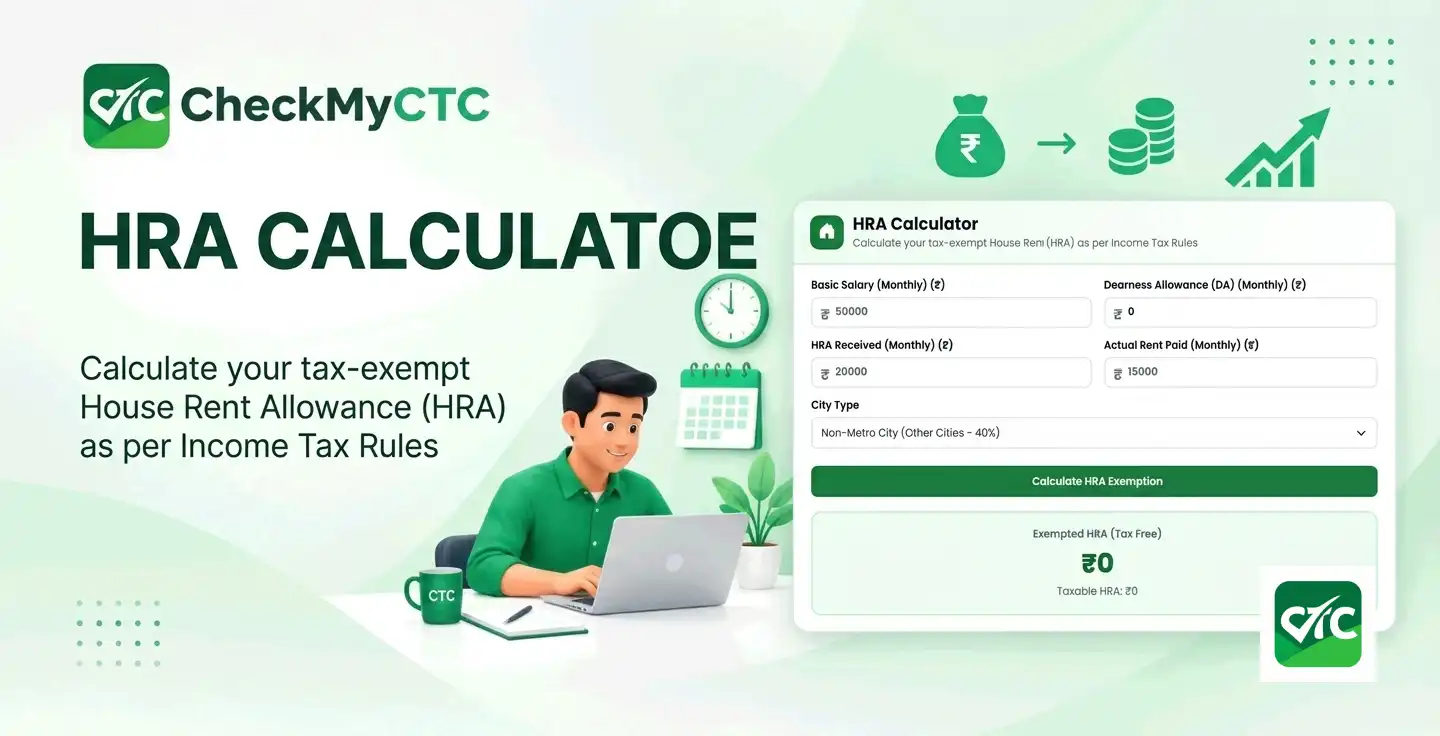
HRA Calculator: How to Calculate House Rent Allowance Tax Exemption in India
If you receive House Rent Allowance (HRA) as part of your salary, you may be able to claim a tax exemption on the eligible portion of that allowance when you meet the applicable conditions. However, the exemption is not automatically equal to your entire HRA or the rent you pay every month.
The calculation depends on your eligible salary, HRA received, rent paid, the location of your rented home and the applicable tax regime. A reliable HRA calculator can help you estimate the eligible exemption and understand how much of your HRA may remain taxable.
In this guide, you will learn how HRA exemption works, which figures you need, how to calculate it with a practical example and which mistakes to avoid. You can also use the CheckMyCTC HRA Calculator to help with your calculation.
What Is House Rent Allowance (HRA)?
House Rent Allowance is a salary component that an employer may provide to help an employee meet residential rental expenses. It is commonly included in the salary structure of employees who live in rented accommodation.
HRA received as part of salary is not automatically fully tax-exempt. Under the applicable HRA exemption rules, an eligible employee may exclude a qualifying amount from taxable salary when the required conditions are satisfied.
The exemption method traditionally associated with Section 10(13A) and Rule 2A of the Income-tax Act, 1961 uses the lowest of three amounts: actual HRA received, rent paid minus 10% of eligible salary, and the applicable percentage of eligible salary based on the location of the rented accommodation.
Eligibility also depends on the tax regime and the relevant tax year. The HRA exemption is not available under the new tax regime for the applicable salary-tax rules. Employees should verify the rules governing their particular tax period before claiming an exemption.
Why Is HRA Exemption Calculation Important?
Calculating HRA exemption helps salaried employees understand the portion of their allowance that may qualify for tax relief and the portion that may remain taxable.
- Salary planning: Understand how HRA fits into your overall salary structure.
- Tax estimation: Estimate the eligible HRA exemption when comparing taxable salary figures.
- Payroll preparation: Prepare the salary and rental information that your employer may request.
- Tax-regime comparison: Understand that HRA exemption eligibility differs between the old and new tax regimes.
- Record keeping: Identify the rent receipts, rental agreement or other supporting information you may need.
The calculated exemption is only one part of your income-tax position. Your final tax liability depends on your other income, eligible deductions, applicable tax rates and other relevant provisions.
Who Should Use an HRA Calculator?
An HRA calculator can be useful for:
- Employees who receive HRA as part of their salary.
- Freshers who want to understand the tax treatment of their first salary package.
- Working professionals who pay monthly rent for residential accommodation.
- Employees reviewing salary slips or preparing investment and tax declarations.
- HR and payroll teams estimating employee HRA exemption amounts.
- Job seekers comparing salary structures that include different HRA components.
People who do not receive HRA can still learn about the rules, but the standard HRA exemption calculation generally will not create an exemption when no qualifying HRA is received. Employees living in their own homes or not actually paying rent generally cannot claim this HRA exemption.
Information Required Before Calculating HRA Exemption
Before calculating your HRA exemption, collect the following information for the relevant rental period.
| Information | What it means | Why it matters |
|---|---|---|
| Basic salary | Your basic pay for the relevant period. | Forms a core component of eligible salary for the calculation. |
| Eligible dearness allowance | DA, where it forms part of salary for retirement benefits. | May be included in the salary base used for HRA exemption. |
| Eligible commission | Commission calculated with reference to a fixed percentage of turnover, where applicable under the relevant definition. | May form part of eligible salary. |
| Actual HRA received | The HRA component paid by your employer for the relevant period. | Sets one of the three limits on the exemption. |
| Actual rent paid | The rent actually paid for the residential accommodation occupied. | Determines the rent-related exemption limit. |
| Location of rented accommodation | Whether the home falls within a location eligible for the 50% salary limit or the 40% salary limit under the traditional method. | Determines the applicable location-based limit. |
| Relevant rental period | The period during which you occupied the rented accommodation and received the relevant salary. | Helps avoid using amounts for months that do not qualify. |
Use figures that relate to the same period. If your salary, rent or HRA changed during the year, a single monthly figure may not accurately represent the full year's exemption.
How to Use the CheckMyCTC HRA Calculator
The CheckMyCTC HRA Calculator is available at the following address:
https://checkmyctc.com/hra-calculator
The calculator is intended to help with HRA exemption calculations. Its exact input fields, available options and displayed results should be confirmed against the live tool before publishing detailed interface instructions. The steps below describe the information generally needed for an HRA exemption estimate.
- Collect your salary details: Check your salary slip for basic pay, eligible DA and other relevant salary components.
- Identify your HRA amount: Find the HRA actually received for the period you want to calculate.
- Calculate the rent paid: Use the actual rent for the corresponding period.
- Identify your rental location: Determine which location-based percentage applies under the relevant rules.
- Enter the information supported by the calculator: Use the available fields and select the relevant options if provided.
- Review the result: Compare the estimated exemption with the HRA received and verify that the figures cover the same period.
- Confirm eligibility: Check the applicable tax regime, supporting documents and current rules before claiming the amount.
A calculator provides a useful estimate, but it does not replace verification of eligibility or the supporting records required for an income-tax claim.
How Does HRA Exemption Calculation Work?
Under the traditional HRA exemption method, the exemption is calculated by comparing three amounts and choosing the lowest eligible amount.
1. Actual HRA received
This is the HRA paid by your employer for the relevant period. The exemption cannot exceed the qualifying HRA received for that period.
2. Rent paid minus 10% of eligible salary
Subtract 10% of eligible salary for the relevant period from the actual rent paid for that period.
If the result is zero or negative, this limit does not provide a positive exemption. If you pay no rent, the HRA exemption is generally zero.
3. The location-based salary limit
The traditional formula uses the following limits:
- 50% of eligible salary: For rented accommodation in Mumbai, Kolkata, Delhi or Chennai.
- 40% of eligible salary: For rented accommodation in other locations.
These percentages are calculation limits, not automatic exemption rates. The lowest of all three amounts determines the exemption under this method.
HRA Exemption Formula
The traditional formula can be expressed as follows:
HRA exemption = Lowest of A, B and C
- A: Actual HRA received.
- B: Actual rent paid minus 10% of eligible salary.
- C: 50% of eligible salary for the specified metropolitan locations, or 40% for other locations.
For this calculation, eligible salary generally comprises basic salary, eligible dearness allowance that forms part of salary for retirement benefits, and qualifying turnover-based commission, where applicable. The relevant salary and rental amounts must correspond to the period concerned.
Taxable HRA component: Where the traditional exemption method applies, the taxable portion of HRA is generally the actual HRA received minus the eligible exemption. This calculation does not by itself determine the employee's total taxable income or final tax liability.
The formula above explains the established method for the relevant period. For tax years governed by updated legislation, verify the corresponding provisions and rules before relying on a particular statutory reference.
HRA Calculation Example With Step-by-Step Working
Consider a hypothetical employee working in Hyderabad who receives HRA and pays rent for a residential property. The employee is assumed to qualify for the traditional HRA exemption method.
For simplicity, assume the following monthly figures remain unchanged throughout 12 months of eligible occupancy.
| Salary or rental component | Monthly amount | Annual amount |
|---|---|---|
| Basic salary | ₹40,000 | ₹4,80,000 |
| Eligible DA | ₹0 | ₹0 |
| HRA received | ₹20,000 | ₹2,40,000 |
| Actual rent paid | ₹15,000 | ₹1,80,000 |
Because Hyderabad falls under the other-location category in the traditional formula, the 40% limit is used in this example.
Step 1: Calculate actual HRA received
Monthly HRA received = ₹20,000.
Annual HRA received = ₹20,000 × 12 = ₹2,40,000.
Step 2: Calculate rent paid minus 10% of eligible salary
Monthly rent paid = ₹15,000.
10% of monthly eligible salary = ₹40,000 × 10% = ₹4,000.
Rent-related limit = ₹15,000 − ₹4,000 = ₹11,000 per month.
Annual rent-related limit = ₹11,000 × 12 = ₹1,32,000.
Step 3: Calculate the 40% salary limit
Monthly salary limit = ₹40,000 × 40% = ₹16,000.
Annual salary limit = ₹16,000 × 12 = ₹1,92,000.
Step 4: Compare all three amounts
| Calculation limit | Monthly amount | Annual amount |
|---|---|---|
| Actual HRA received | ₹20,000 | ₹2,40,000 |
| Rent minus 10% of eligible salary | ₹11,000 | ₹1,32,000 |
| 40% of eligible salary | ₹16,000 | ₹1,92,000 |
The lowest amount is ₹11,000 per month, or ₹1,32,000 annually.
Step 5: Estimate the taxable HRA component
Annual HRA received = ₹2,40,000.
Estimated annual HRA exemption = ₹1,32,000.
Taxable HRA component = ₹2,40,000 − ₹1,32,000 = ₹1,08,000.
In this hypothetical example, ₹1,32,000 qualifies for exemption and ₹1,08,000 remains taxable as the HRA component, assuming all eligibility conditions are satisfied and the traditional method applies.
This is an illustration of the HRA calculation, not a calculation of the employee's final income tax. Other salary components, deductions, exemptions and the applicable tax regime can affect the overall tax position.
Understanding Your HRA Calculator Result
When reviewing an HRA exemption estimate, distinguish between the following amounts.
- HRA received: The total allowance paid by the employer for the period.
- Eligible HRA exemption: The amount that may qualify for exemption after applying the relevant limits and conditions.
- Taxable HRA: The portion of HRA that remains taxable after deducting the eligible exemption, where that exemption is available.
- Total taxable salary: A broader figure that takes account of the relevant salary components and applicable tax provisions.
- Final income tax: The tax calculated after considering the applicable regime, other income, permitted deductions, rebates and other relevant rules.
An HRA exemption amount is not the same as tax saved. For example, an exemption of ₹1,32,000 does not mean that the employee receives ₹1,32,000 as a refund or cash benefit. It is an amount excluded from taxable income when the relevant conditions are met.
HRA Exemption: 40% vs 50% Salary Limit
The location-based percentage is one part of the traditional formula. It should not be confused with the final exemption amount.
| Factor | 50% limit | 40% limit |
|---|---|---|
| Location under the traditional rule | Mumbai, Kolkata, Delhi or Chennai | Other locations |
| Salary of ₹40,000 per month | ₹20,000 per month | ₹16,000 per month |
| Does this automatically become the exemption? | No | No |
| Other limits still apply | Actual HRA received and rent paid minus 10% of eligible salary | Actual HRA received and rent paid minus 10% of eligible salary |
The table illustrates only the salary-percentage limit. The final exemption may be lower because the other limits can reduce the qualifying amount.
HRA Exemption Under the Old and New Tax Regimes
The tax regime is an important eligibility consideration before using an HRA calculation to plan your taxes.
| Consideration | Old tax regime | New tax regime |
|---|---|---|
| HRA exemption | May be available when the applicable conditions are satisfied. | Not available under the applicable new-regime salary-tax rules. |
| Rent payment | Actual rent and eligible salary are relevant to the calculation. | Paying rent alone does not make HRA exemption available. |
| Tax planning | Evaluate HRA along with other eligible deductions and exemptions. | Evaluate the tax liability under the rules and benefits available in the new regime. |
Neither regime is automatically better for every employee. The appropriate choice depends on the person's income, eligible deductions, exemptions and overall circumstances. Compare the complete tax liability under both regimes rather than making a decision based only on HRA.
For current information, consult the Income Tax Department's guidance on the old and new tax regimes.
Practical Benefits and Use Cases of an HRA Calculator
For employees reviewing their salary slips
An HRA calculator can help employees understand the relationship between basic salary, HRA received and actual rent paid. This can be useful when checking payroll estimates or preparing a tax declaration.
For freshers comparing job offers
Two job offers with similar annual CTC can have different salary structures. Reviewing the basic salary and HRA components can help candidates understand how those differences may affect their eligible HRA exemption, where applicable.
For employees planning tax declarations
Employees may use an estimate to prepare the information their employer requests. They should retain genuine rental records and submit the documents required by their employer or the applicable tax rules.
For HR and payroll teams
A consistent calculation method can help payroll teams explain the difference between HRA received, eligible exemption and taxable HRA. The result should still be reviewed against employee-specific information and the rules applicable to the relevant period.
Common HRA Calculation Mistakes to Avoid
- Assuming all HRA is tax-free: The exemption is limited by the applicable calculation method.
- Using total CTC as eligible salary: The salary base for HRA exemption is not automatically the same as total CTC.
- Ignoring the rent paid: The actual rent payment affects the rent-related limit.
- Applying the wrong location percentage: Confirm the relevant location category under the applicable rules.
- Claiming exemption without paying rent: The traditional HRA exemption generally requires actual rental expenditure for qualifying residential accommodation.
- Ignoring the tax regime: The new tax regime does not allow the HRA exemption available under the old regime's applicable rules.
- Mixing monthly and annual amounts: Compare figures from the same period.
- Ignoring salary changes: Salary revisions, changes in HRA or changes in rent can affect the result for different months.
- Using inaccurate records: Enter actual figures and retain genuine rent receipts and other supporting documents.
- Confusing exemption with tax savings: An exempt amount is not the same as a refund or the final amount of tax saved.
Factors That Can Affect Your HRA Exemption
The amount of eligible HRA exemption can vary depending on several factors.
- Basic salary and eligible salary components: These determine the salary base used for the calculation.
- Actual HRA received: A lower HRA allowance can limit the exemption.
- Monthly rent: The amount actually paid influences the rent-related limit.
- Rental location: The traditional formula applies different salary percentages according to location.
- Rental period: The exemption relates to the period during which the qualifying rented accommodation was occupied.
- Changes during the year: Salary revisions, changes in rent or moving to a different home may require separate calculations for different periods.
- Tax regime: Eligibility depends on the regime applicable to the relevant tax period.
- Documentation: Missing or inconsistent records may affect whether a claim can be substantiated.
Limitations and Important Considerations
An HRA calculator is a calculation aid, not an official determination of tax eligibility. A result depends on the accuracy of the inputs and whether the correct method and applicable rules are used.
- Do not assume that a calculator result confirms that you are legally eligible to claim the exemption.
- Use the salary components and calculation period prescribed by the relevant rules.
- Keep genuine rent receipts, rental agreements and any other supporting records required for your circumstances.
- Check your employer's documentation requirements and the applicable tax provisions before making a declaration or filing a return.
- Review current official guidance where legislation or rules have changed.
- Consider consulting a qualified tax professional if your circumstances involve multiple properties, complex salary arrangements, changes in residence or uncertainty about eligibility.
For the traditional exemption formula, the Income Tax Department's published guidance explains the three limits used in the calculation. See the official HRA taxability guidance. Verify the provisions applicable to the particular tax year before using an older statutory reference.
Frequently Asked Questions About HRA Calculators
1. What is an HRA calculator?
An HRA calculator is a tool that helps estimate the House Rent Allowance exemption based on relevant salary, HRA and rental information. The result depends on the applicable rules, eligibility conditions and accuracy of the inputs.
2. How is HRA exemption calculated in India?
Under the traditional method, the exemption is the lowest of actual HRA received, rent paid minus 10% of eligible salary, and 50% or 40% of eligible salary depending on the rental location. The calculation applies only when the relevant eligibility conditions are satisfied.
3. Is the full HRA amount tax-exempt?
No. The exemption may be lower than the HRA received because of the rent-related and salary-percentage limits. The remaining HRA is generally taxable when the exemption method applies.
4. Can I claim HRA exemption under the new tax regime?
No. HRA exemption available under the old regime's applicable rules is not available under the new tax regime's salary-tax rules. Check the official guidance for the relevant tax period before preparing your tax declaration.
5. Can I claim HRA exemption if I live in my own house?
Generally, no HRA exemption is available when you live in accommodation owned by you and do not pay qualifying rent for the accommodation. Eligibility depends on the actual circumstances and applicable rules.
6. Can I claim HRA exemption if I pay rent but do not receive HRA?
Paying rent alone does not create an HRA exemption. The traditional HRA calculation requires HRA received as well as qualifying rental expenditure. Other tax provisions, if relevant, must be evaluated separately.
7. Does the 50% HRA limit apply to every city?
No. Under the traditional formula, the 50% salary limit applies to rented accommodation in Mumbai, Kolkata, Delhi and Chennai. The 40% limit applies to other locations. The final exemption is still the lowest of the three applicable amounts.
8. Does HRA exemption mean I will receive a tax refund?
No. HRA exemption reduces the amount of eligible HRA included in taxable salary. A tax refund depends on the overall tax liability and the tax already paid or deducted. The exemption amount is not itself a refund.
Conclusion: Calculate Your HRA Exemption With CheckMyCTC
Understanding HRA exemption can help you review your salary structure, prepare rental records and estimate the taxable portion of your allowance. The key is to use the correct eligible salary, actual HRA, rent paid, location-based limit and tax regime for the relevant period.
Before claiming an exemption, verify that you satisfy the applicable conditions and retain genuine supporting documents. Remember that an HRA estimate does not determine your complete income-tax liability.
Ready to work through your HRA figures? Visit the CheckMyCTC HRA Calculator to get started with your calculation.
Explore All CheckMyCTC Calculators & Tools
Explore our free salary, tax, HR and productivity tools to calculate salary changes, estimate employee benefits, manage employment dates and simplify everyday tasks.
Salary & CTC Calculators
- Salary Hike Calculator
- Overtime Pay Calculator
- Monthly Salary to Annual Package Calculator
- Annual Package to Monthly Salary Calculator
- Take-Home Salary Calculator
- CTC Breakup Generator
- Monthly Bonus Calculator
- Annual Bonus Calculator
- Job Offer Comparison Calculator
- Pro Rata Salary Calculator
Tax, PF & Employee Benefits
- HRA Tax Exemption Calculator
- EPF Provident Fund Calculator
- Gratuity Calculator
- LTA Calculator
- Professional Tax Calculator
- Income Tax Calculator
- National Pension System (NPS) Calculator
- ESI Calculator
- GST Calculator
Leave & Employment Calculators
- Work Experience Calculator
- Last Working Day Calculator
- Resignation Date Calculator
- Leave Amount & Salary Deduction Calculator
- Notice Period Calculator
- Earned Leave Encashment Calculator
- Sandwich Leave Calculator
- Maternity & Paternity Leave Calculator
Salary Documents & Generators
- Payslip Generator
- Salary Certificate Generator
- Experience & Relieving Letter Generator
- QR Code Generator
Phone Number & Productivity Tools
Leave a Comment
Comments
No comments yet. Be the first to comment!