EPF Wage Ceiling Increased to ₹25,000: New EPFO Rules 2026
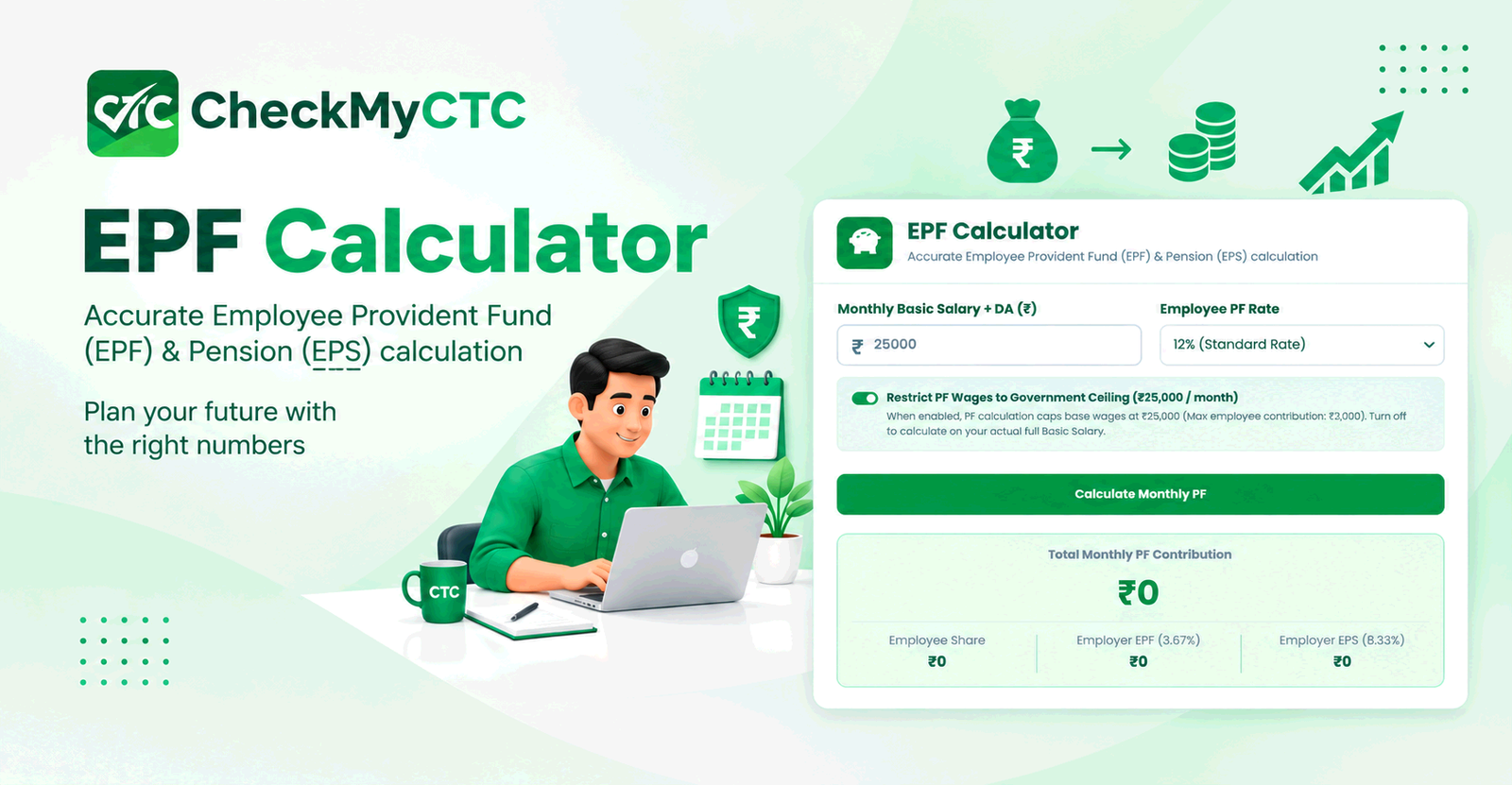
EPF New Rules 2026: Wage Ceiling Increased from ₹15,000 to ₹25,000
The Government of India has announced an important update to the Employees’ Provident Fund (EPF) framework. The wage ceiling for mandatory coverage under the Employees’ Provident Fund Organisation (EPFO) has been increased from ₹15,000 to ₹25,000 per month, effective from 17 September 2026. The revision is intended to extend social security coverage to a larger number of eligible employees in India.
This update is relevant to salaried employees, HR professionals, payroll teams, employers and people who want to understand their monthly Provident Fund deductions. The revised wage ceiling may affect employee enrolment, employer contributions and the calculation of retirement benefits, depending on the employee’s salary, existing EPF membership and the applicable scheme provisions.
In this article, CheckMyCTC explains the latest EPF wage ceiling update, what has changed, who may be affected, how EPF and EPS work, and what employees should check in their salary slips after the revision.
What Is the Latest EPF Update in 2026?
The Ministry of Labour and Employment has notified an increase in the statutory wage ceiling for mandatory EPFO coverage. The earlier ceiling was ₹15,000 per month, and the revised ceiling is ₹25,000 per month. The change took effect on 17 September 2026.
According to the Government of India’s announcement, the revision is expected to bring more than 51 lakh additional employees within mandatory EPFO coverage. The change expands the range of wages covered by the statutory framework and may extend access to provident fund savings, pension benefits and insurance protection to eligible workers.
The wage ceiling had remained at ₹15,000 since September 2014. The latest revision updates this threshold in response to changes in wage levels and the expansion of formal employment.
Employees and employers should refer to the official notification and applicable EPFO instructions to understand how the revised ceiling applies to their particular employment situation.
EPF Wage Ceiling: Old Limit vs New Limit
| Particulars | Earlier Limit | Revised Limit |
|---|---|---|
| Monthly wage ceiling | ₹15,000 | ₹25,000 |
| Effective date of revised ceiling | September 2014 limit | 17 September 2026 |
| Purpose | Mandatory EPFO coverage threshold | Expanded mandatory coverage threshold |
The revised amount is a wage ceiling used for determining mandatory coverage under the applicable legal framework. It should not automatically be interpreted as a universal limit on every employee’s PF contribution. Actual contribution calculations can depend on applicable wages, membership status, scheme provisions and the employer’s contribution arrangements.
Who May Be Affected by the New ₹25,000 EPF Wage Ceiling?
The revision is particularly relevant to employees whose applicable monthly wages are above the previous ₹15,000 ceiling but do not exceed ₹25,000. Some employees in this wage range who were previously outside mandatory coverage may now become eligible for coverage, subject to the applicable legal and scheme conditions.
For example, consider an employee whose applicable monthly wages are ₹20,000. Under the earlier wage ceiling, the employee’s eligibility for mandatory coverage could differ from that of an employee earning ₹15,000 or less. With the revised ceiling, the employee may fall within the expanded coverage range, provided the other eligibility requirements are satisfied.
However, salary alone may not determine every employee’s EPF position. Existing EPF membership, the nature of employment, the establishment’s coverage and the relevant statutory provisions can affect the outcome. Employees should confirm their eligibility with their employer’s HR or payroll department rather than assuming that the same rule applies to everyone.
What Is the Employees’ Provident Fund (EPF)?
The Employees’ Provident Fund is a retirement savings arrangement for eligible employees working in establishments covered by the applicable law. Contributions are made during employment, helping employees build savings for the future.
In a typical EPF arrangement, both the employee and the employer contribute a percentage of the applicable wages. The employee’s contribution is deducted from salary, while the employer makes its own contribution according to the relevant rules. The contributions credited to the employee’s EPF account help build a retirement corpus over time.
The actual amount credited to the EPF account depends on the applicable wage basis, contribution rates, statutory provisions and any relevant limits. Employees can review their salary slips and EPFO passbook to check whether contributions have been deposited correctly.
How Does the EPF Contribution Calculation Work?
EPF contributions are generally calculated as a percentage of eligible wages. A commonly used contribution rate for covered employees is 12% of the applicable wage amount, subject to the relevant provisions and exceptions.
For illustration, if the applicable monthly wage used for an employee’s contribution calculation is ₹20,000 and a 12% employee contribution applies, the employee contribution would be ₹2,400 per month.
This is a mathematical illustration, not a guarantee that every employee earning ₹20,000 will have a ₹2,400 deduction. The actual contribution depends on the wage components used for PF purposes, the employee’s coverage and the applicable rules.
Similarly, the employer’s contribution should not always be treated as an identical amount credited entirely to the employee’s EPF balance. Where applicable, part of the employer’s contribution may be allocated to the Employees’ Pension Scheme (EPS), with the remaining amount credited to EPF according to the relevant rules.
What Is the Difference Between EPF and EPS?
EPF and EPS are related but serve different purposes.
Employees’ Provident Fund (EPF)
EPF is primarily a savings arrangement that helps employees accumulate funds for retirement. Contributions and applicable interest build the member’s EPF balance. Eligible members may also be able to make withdrawals or advances under the relevant rules.
Employees’ Pension Scheme (EPS)
EPS provides pension-related benefits to eligible members, subject to the scheme’s conditions. The employer’s contribution is allocated between EPF and EPS as prescribed by the applicable rules. EPS eligibility and pension calculations depend on factors such as pensionable salary, eligible service and the scheme provisions.
Employees should understand that the amount allocated to EPS is not simply another portion of their personal EPF savings balance. EPF and EPS have different purposes, account treatment and benefit calculations.
Will the New Wage Ceiling Increase Your Monthly PF Deduction?
The effect of the revised ceiling will vary from employee to employee. Some workers may become newly covered under the mandatory EPFO framework. Others may already be EPF members whose contribution calculations are affected by the revised wage ceiling or related implementation instructions.
Where the applicable contribution wage increases, the employee’s monthly PF deduction may also increase. A higher employee contribution can reduce monthly take-home salary, while potentially increasing the amount saved toward retirement. The employer’s contribution and its allocation between EPF and EPS may also change where the revised rules apply.
Employees should not assume that their deduction will automatically increase to a particular amount simply because the wage ceiling is now ₹25,000. The result depends on their individual circumstances and the applicable contribution calculation.
What Should Employees Check in Their Salary Slip?
After the revised ceiling takes effect, employees can review their salary slips and EPFO records to understand how their contributions are being handled. The following items are useful to check:
- PF wages: Check the wage amount used by your employer for PF calculations.
- Employee PF contribution: Confirm the deduction shown in your monthly salary slip.
- Employer contribution: Review the employer’s contribution information where it is provided.
- EPS allocation: Understand whether part of the employer’s contribution is allocated to the pension scheme.
- EPFO passbook: Check whether the relevant contributions have been credited to your account.
- UAN and KYC: Ensure that your Universal Account Number and required KYC details are accurate.
If the contribution shown on your salary slip differs from the amount credited to your EPFO account, contact your HR or payroll team for clarification. Keep your salary slips and relevant records available when raising a query.
How Can Employers and HR Teams Prepare?
Employers and payroll teams should review the revised wage ceiling and the official implementation instructions. Payroll software, employee records and contribution calculations may need to be updated for employees who fall within the revised coverage framework.
HR teams should identify employees who may be affected, verify the applicable wage components and confirm the correct treatment of EPF and EPS contributions. They should also communicate any changes in payroll deductions clearly to employees.
Employers should use the official notification, EPFO guidance and applicable statutory provisions when making compliance decisions. A general online calculator or an informal interpretation should not replace a proper payroll or compliance review.
Calculate Your PF with the CheckMyCTC EPF Calculator
Understanding PF deductions can be confusing, especially when salary components, employer contributions and pension allocations are involved. The CheckMyCTC EPF Calculator helps users estimate employee and employer Provident Fund contributions using the salary details they enter.
You can use the calculator to explore how different monthly Basic Salary and Dearness Allowance amounts may affect estimated PF contributions. It can also help you understand the difference between the employee contribution, the employer’s EPF share and the employer’s EPS share, where applicable.
For a more useful estimate, enter the salary components relevant to your PF calculation and select the appropriate contribution settings. Compare the result with your salary slip and confirm the applicable calculation with your employer or payroll team.
Important: The ₹25,000 wage ceiling relates to mandatory coverage under the revised framework. It should not be applied as a universal PF contribution cap for every employee without checking the applicable statutory and scheme provisions. Use the calculator as an estimate, not as an official determination of eligibility or payroll compliance.
Frequently Asked Questions About the EPF New Rules 2026
1. What is the new EPF wage ceiling in 2026?
The wage ceiling for mandatory EPFO coverage has increased from ₹15,000 to ₹25,000 per month, effective from 17 September 2026.
2. When did the revised EPF wage ceiling take effect?
The revised ceiling took effect on 17 September 2026, according to the Government of India’s announcement and notification.
3. Does the new limit mean every employee earning below ₹25,000 must be enrolled?
The revised ceiling expands the range of employees who may fall within mandatory coverage. Individual eligibility remains subject to the applicable legal provisions, scheme conditions and employment circumstances.
4. Will my PF deduction increase after the revision?
Your deduction may change if the revised wage ceiling affects your applicable contribution wages or coverage. The actual impact depends on your salary structure, existing membership and the rules applicable to you.
5. Is the ₹25,000 ceiling the same as the maximum PF contribution for everyone?
No. The wage ceiling for mandatory coverage should not be confused with a universal contribution cap applying to every employee. Contribution calculations depend on the applicable wage basis and statutory provisions.
6. Where can I check my PF contribution?
You can review the PF deduction in your salary slip and check contribution credits through your EPFO member account and passbook. Contact your HR or payroll team if you need help understanding a difference.
Conclusion
The increase in the EPFO wage ceiling from ₹15,000 to ₹25,000 per month is an important change for India’s salaried workforce. Effective from 17 September 2026, the revised ceiling is expected to extend mandatory social security coverage to more eligible employees, including workers in the wage range that was above the previous threshold.
The effect on an individual employee’s PF deduction, employer contribution, EPS allocation and take-home salary will depend on the applicable rules and personal employment circumstances. Employees should review their salary slips, check their EPFO records and seek clarification from HR or payroll teams when necessary.
For a quick estimate of your monthly PF contributions, use the CheckMyCTC EPF Calculator. It can help you understand the figures involved and compare estimated contributions with your salary details.
Disclaimer: This article is for general informational and educational purposes only. It is not legal, tax, payroll or financial advice. EPF coverage and contribution calculations are subject to the applicable laws, official notifications, EPFO instructions and individual circumstances. Refer to official government and EPFO sources or consult a qualified professional for decisions relating to your employment or statutory compliance.
Official Government Sources
- Press Information Bureau – Cabinet Approves Higher EPFO Wage Ceiling of ₹25,000
- Press Information Bureau – Central Government Raises Statutory Wage Ceiling under EPF to ₹25,000
Calculate Your PF with the CheckMyCTC EPF Calculator
Understanding PF deductions can be confusing, especially when salary components, employee contributions, employer contributions and pension allocations are involved. The CheckMyCTC EPF Calculator is a free online tool designed to help employees estimate their monthly EPF and EPS-related amounts.
Enter your Monthly Basic Salary + DA, select the applicable employee PF rate and use the available calculation options to estimate the employee share, employer EPF share and employer EPS allocation.
Calculate your PF now: https://checkmyctc.com/pf-calculator
Explore All CheckMyCTC Calculators & Tools
Explore our free salary, tax, HR and productivity tools to calculate salary changes, estimate employee benefits, manage employment dates and simplify everyday tasks.
Salary & CTC Calculators
- Salary Hike Calculator
- Overtime Pay Calculator
- Monthly Salary to Annual Package Calculator
- Annual Package to Monthly Salary Calculator
- Take-Home Salary Calculator
- CTC Breakup Generator
- Monthly Bonus Calculator
- Annual Bonus Calculator
- Job Offer Comparison Calculator
- Pro Rata Salary Calculator
Tax, PF & Employee Benefits
- HRA Tax Exemption Calculator
- EPF Provident Fund Calculator
- Gratuity Calculator
- LTA Calculator
- Professional Tax Calculator
- Income Tax Calculator
- National Pension System (NPS) Calculator
- ESI Calculator
- GST Calculator
Leave & Employment Calculators
- Work Experience Calculator
- Last Working Day Calculator
- Resignation Date Calculator
- Leave Amount & Salary Deduction Calculator
- Notice Period Calculator
- Earned Leave Encashment Calculator
- Sandwich Leave Calculator
- Maternity & Paternity Leave Calculator
Salary Documents & Generators
- Payslip Generator
- Salary Certificate Generator
- Experience & Relieving Letter Generator
- QR Code Generator
Phone Number & Productivity Tools
Leave a Comment
Comments
No comments yet. Be the first to comment!