Best Free Notice Period Calculator – Calculate Your Last Working Day and Buyout Amount
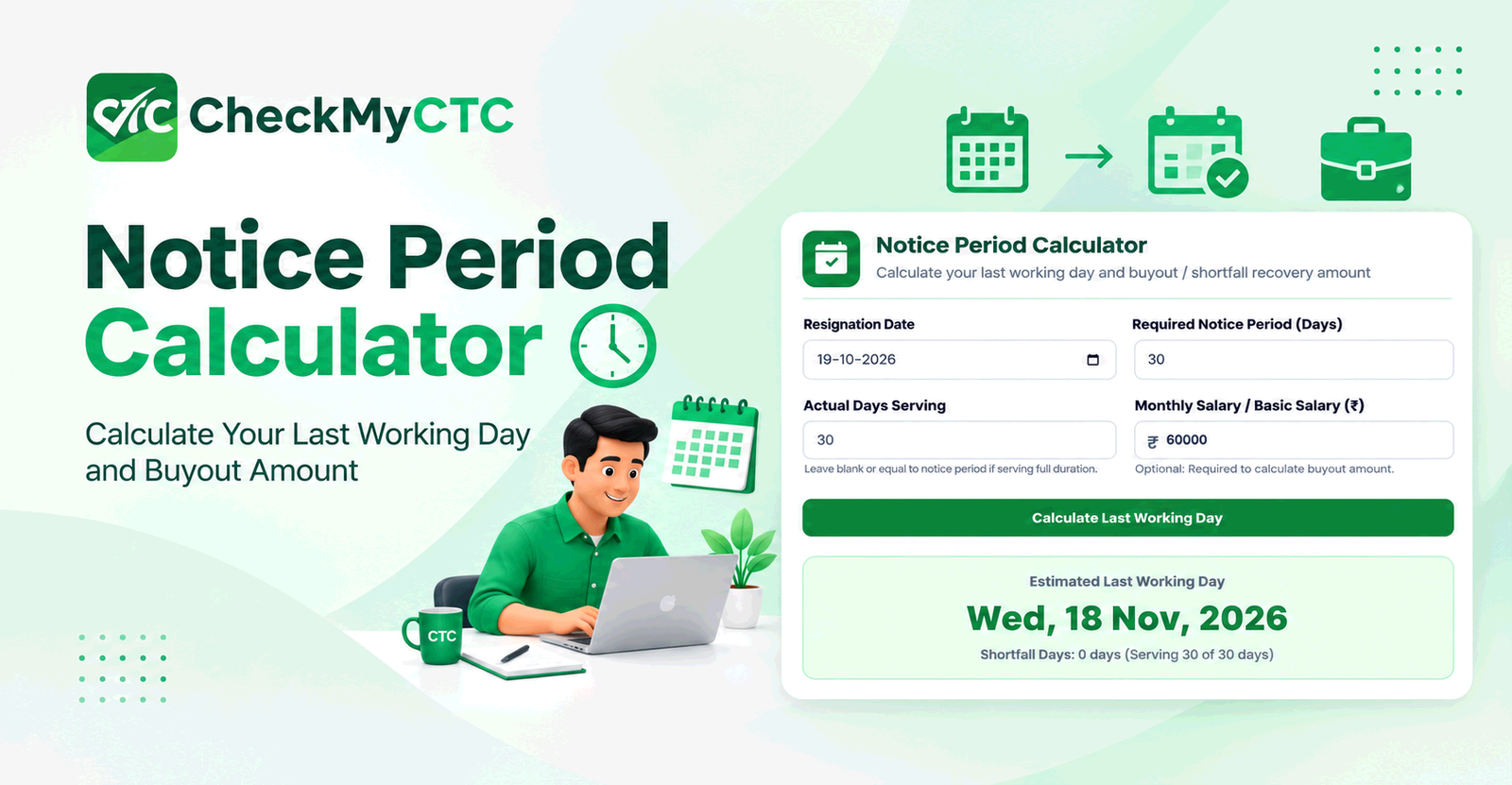
Best Free Notice Period Calculator – Calculate Your Last Working Day and Buyout Amount
Planning to resign from a job often involves more than submitting a resignation letter. Employees need to understand when their notice period ends, how many days they are expected to serve, and whether leaving early could result in a notice period buyout or shortfall recovery amount.
Calculating these details manually can be confusing, especially when the resignation date, weekends, holidays, leave approvals, and company policies affect the final working date. A Notice Period Calculator helps simplify this process by estimating your last working day and the potential amount associated with an unserved notice period.
The CheckMyCTC Notice Period Calculator is designed to help employees understand these calculations before discussing their resignation timeline with HR. The result is useful for planning, but your employment agreement and employer's final confirmation remain important.
What Is a Notice Period Calculator?
A notice period is the period an employee is expected to serve between communicating their resignation and leaving the organisation, subject to the applicable employment terms and company policies. The required period may differ according to the employment agreement, role, length of service, or other applicable conditions.
A Notice Period Calculator is an online tool that helps estimate the final working date and, where the required information is available, the potential buyout or shortfall recovery amount.
Depending on the calculator's available inputs, you may need information such as:
- Resignation date: The date on which you submitted or formally communicated your resignation.
- Required notice period: The number of days or months specified in your employment terms.
- Proposed last working day: The date you would like to leave, if you are requesting an early release.
- Applicable salary amount: The salary basis used by your employer to calculate any notice period shortfall.
- Notice period already served: The period completed before your proposed departure, if relevant to the calculation.
The actual fields available may vary. Use the information requested by the calculator and check that it matches your employment situation before relying on the result.
Why Do Employees Need a Notice Period Calculator?
Resignation dates and notice period obligations can affect job transitions, joining dates, salary planning, and discussions with HR. A small misunderstanding about the number of days remaining can create avoidable confusion.
For example, suppose your new employer expects you to join on a particular date, but your current employer requires you to complete a longer notice period. You may need to calculate your expected last working day and discuss whether an earlier release is possible.
A calculator can help you prepare for that discussion by showing an estimated date and, when applicable, a potential financial shortfall.
It is particularly useful when you want to:
- Estimate your last working day before submitting a resignation.
- Check how much of your notice period remains.
- Understand the potential cost of leaving before completing the required period.
- Plan a transition between your current job and a new opportunity.
- Prepare questions for HR or payroll about notice period recovery.
- Compare a proposed early release date with the date calculated from your notice period.
How to Use the CheckMyCTC Notice Period Calculator
You can use the calculator to work through the information relevant to your resignation. The exact inputs depend on the fields provided in the tool.
- Open the calculator: Visit the CheckMyCTC Notice Period Calculator page.
- Enter the resignation date: Use the appropriate date based on your employer's resignation process.
- Provide the required notice period: Check your appointment letter, employment agreement, or applicable HR policy for the required duration.
- Enter the proposed leaving date or other requested details: If you intend to leave early, provide the relevant information requested by the calculator.
- Provide salary information if required: Use the salary component and pay period requested by the tool. Do not assume that every employer uses the same salary basis for recovery.
- Review the calculated result: Check the estimated last working day and any displayed notice period buyout or shortfall amount.
- Confirm the details with HR: Before making a final decision, verify the dates, applicable policy, and any amount payable or recoverable.
For the most useful result, collect your employment terms and relevant dates before starting the calculation. If you have not yet received confirmation of your resignation date, treat the calculated date as provisional.
Understanding Notice Period Calculations
Two different calculations are often involved in resignation planning: determining the last working day and estimating the amount associated with an unserved notice period. Understanding the difference helps prevent mistakes.
1. Calculating the Last Working Day
The expected last working day depends on the resignation date, the required notice period, and the way your employer counts the notice period.
For a straightforward example, assume an employee's notice period starts on 1 November and the employer counts 30 calendar days from that date as the notice period. Under this assumption, the 30th day is 30 November.
However, the result can change if the employer counts the notice period from the day after resignation, uses a different date as the effective start date, or applies a specific rule for the completion of the period. Weekends and public holidays may also affect the practical relieving date if the employer's policy or working arrangements make them relevant.
Therefore, a date calculation should be treated as an estimate until the employer confirms the effective resignation date and last working day.
2. Calculating the Notice Period Shortfall
A notice period shortfall is the portion of the required notice period that an employee does not serve, where the employer's terms provide for a shortfall calculation.
A simple way to understand it is:
Notice period shortfall = Required notice period − Notice period served
This simplified formula assumes both periods use the same counting method and that the employee has not received an approved waiver or other adjustment. The result should not be negative; if the employee has completed the required period, there is generally no unserved period under this simple calculation.
For example, if the required notice period is 60 days and the employee serves 45 days, the unserved portion is 15 days, assuming both periods are counted consistently.
3. Estimating the Buyout or Recovery Amount
Some employment agreements allow an employee to request an early release by paying an amount related to the unserved notice period. In other situations, the employer may calculate a recovery under the applicable employment terms. The availability and treatment of these arrangements depend on the agreement, employer policy, and applicable law.
Where the employer uses a daily salary rate, a simplified illustrative calculation is:
Estimated shortfall amount = Daily salary rate × Unserved notice days
The daily salary rate may be derived from a specified monthly salary divided by the number of days prescribed by the employer's calculation method. Some employers use a particular salary component or another contractual basis. Consequently, the simplified formula is an explanation of the calculation concept, not a universal rule for determining an employee's liability.
Check which salary components and day-counting method apply before treating any calculated amount as payable.
Practical Example: Last Working Day and Notice Period Buyout
Consider the following hypothetical example to understand how the calculations may work.
An employee has submitted a resignation and has a required notice period of 60 days. After serving 45 days, the employee requests an early release because a new employer has offered an earlier joining date.
Assume, only for illustration, that the employer's applicable calculation uses a monthly salary of ₹30,000, divided by 30 days, to determine the daily rate.
| Calculation detail | Illustrative value |
|---|---|
| Required notice period | 60 days |
| Notice period served | 45 days |
| Unserved notice period | 15 days |
| Monthly salary used for this example | ₹30,000 |
| Illustrative daily salary rate | ₹30,000 ÷ 30 = ₹1,000 |
| Illustrative shortfall amount | 15 × ₹1,000 = ₹15,000 |
Under these assumptions, the estimated amount is ₹15,000. This is a mathematical example, not a confirmation that the employee must pay that amount.
The employer may use a different salary basis, day-counting method, or contractual arrangement. The employer may also agree to waive some or all of the remaining period, subject to the applicable terms.
In this example, the employee should verify the proposed last working day and any recovery amount with HR before accepting the new joining date. The actual outcome depends on the employer's approval and applicable employment terms.
Who Can Use a Notice Period Calculator?
The calculator can be useful for several groups of people dealing with employment transitions.
- Employees planning to resign: Estimate the expected end of the notice period before communicating a final departure plan.
- Professionals changing jobs: Compare a potential last working day with the joining date offered by a new employer.
- Freshers: Understand how a notice period may affect the transition from a first job to another opportunity.
- Employees requesting early release: Estimate the unserved period and prepare to discuss possible arrangements with HR.
- HR professionals: Use date and shortfall calculations as a preliminary reference when reviewing employee queries.
- Payroll teams: Understand the figures an employee may be asking about before verifying them against the organisation's payroll process.
The tool is intended to support understanding and planning. It does not replace the employer's formal resignation approval or an official payroll calculation.
Key Benefits of Using an Online Notice Period Calculator
- Faster date estimation: Calculate a provisional last working day without manually counting every day on a calendar.
- Better resignation planning: Understand the likely timeline before coordinating with a new employer.
- Shortfall awareness: Estimate the unserved notice period when considering an early departure.
- Financial preparation: Understand a possible buyout or recovery amount before discussing the applicable terms with HR.
- Clearer conversations: Prepare specific questions about dates, salary calculations, and employer policies.
- Reduced arithmetic effort: Avoid common counting and multiplication errors when working with dates and salary figures.
These benefits depend on entering the correct information and interpreting the result according to your actual employment terms.
Online Notice Period Calculator vs Manual Calculation
Both an online calculator and a manual calculation can help estimate a last working day or notice period shortfall. The main difference is how the calculation is performed and how easily assumptions can be reviewed.
| Factor | Online calculator | Manual calculation |
|---|---|---|
| Time required | Can produce an estimate quickly after the required details are entered. | May require manually counting dates and working through the arithmetic. |
| Date counting | Uses the calculation logic implemented by the tool. | Depends on the person's counting method and calendar checks. |
| Salary calculation | Can calculate an estimate based on the inputs and assumptions available. | Requires the user to select the applicable salary basis and perform the arithmetic. |
| Flexibility | Limited to the inputs and options supported by the calculator. | Can accommodate more complex scenarios if the user understands the required rules. |
| Policy verification | Does not independently establish an employer's contractual policy. | Still requires checking the employment agreement and relevant policy. |
| Reliability of the final outcome | Provides an estimate based on the information entered and implemented logic. | Can be useful when calculated correctly with the right assumptions. |
An online calculator is convenient for a preliminary estimate, while manual calculation can help you understand each step. Neither method can independently confirm an employer's final decision or establish a disputed contractual obligation.
Notice Period Buyout vs Notice Period Recovery
The terms buyout and recovery are sometimes used interchangeably in workplace conversations, but they can refer to different arrangements depending on the employer's policy and employment agreement.
Notice period buyout
A buyout generally refers to an arrangement under which an employee seeks to leave before completing the required notice period, with a payment or other agreed treatment for the unserved portion where the applicable terms permit it. Approval may be necessary, and payment alone does not automatically establish that an employee can leave on a chosen date.
Notice period recovery
Recovery generally refers to an amount an employer seeks to recover under the applicable employment terms for a notice period that was not served. The contractual basis, calculation method, and circumstances in which recovery applies need to be checked individually.
For either arrangement, confirm whether the employer permits an early release, whether the amount is calculated using basic salary or another salary component, and whether a waiver or adjustment is possible.
Common Notice Period Calculation Mistakes to Avoid
Even a straightforward calculation can produce an incorrect expectation if the underlying details are wrong. Before using the result for a resignation decision, check the following points.
- Using the wrong resignation date: The date you drafted a resignation letter may differ from the date your employer recognises as the effective resignation date.
- Assuming every notice period starts on the same basis: Your employment terms may specify how the start date is determined and whether the submission or acceptance date matters.
- Mixing calendar days with working days: A period counted in calendar days is not necessarily the same as a period counted in working days.
- Ignoring the actual notice period in your agreement: Do not assume that another employee's notice period applies to your role.
- Using the wrong salary figure: Gross salary, basic salary, and total cost to company (CTC) are different measures. Do not substitute one for another unless it matches the applicable calculation basis.
- Assuming the buyout amount is universal: Employers may use different contractual terms and salary calculation methods.
- Assuming leave automatically reduces the notice period: Leave approval and its effect on the notice period depend on the applicable policy and agreement.
- Treating an estimate as approval: A calculated date does not confirm that your employer has accepted your resignation or approved an early release.
- Ignoring written confirmation: Keep the employer's confirmation of the effective resignation date, final working day, and any agreed settlement terms.
Limitations and Important Considerations
A Notice Period Calculator is useful for estimating dates and amounts, but several factors can change the final outcome.
- Employment agreement: The contract may define the required notice period, how it is counted, and the conditions for early release.
- Employer policy: The organisation may have specific procedures for resignation acceptance, leave, handover, and relieving dates.
- Salary basis: Any shortfall calculation may depend on the salary component specified in the applicable terms.
- Day-counting method: Calendar days, working days, and the treatment of the start and end dates can produce different results.
- Approved waiver or early release: An employer may agree to a different departure date or waive part of the notice period where permitted.
- Leave and holidays: The effect of leave, weekly offs, and holidays depends on the relevant rules and circumstances.
- Applicable law: Employment conditions and enforceability can depend on the applicable law, employment category, and circumstances.
- Final settlement: The eventual amount payable or recoverable may differ from a simple shortfall estimate because other applicable payroll items or agreed adjustments may need to be considered.
For these reasons, do not treat a calculator output as a final demand, legal determination, or confirmed settlement amount. If the amount is significant or a dispute arises, review your employment agreement and seek clarification from HR, payroll, or an appropriately qualified employment-law professional.
How CheckMyCTC Helps With Resignation Planning
CheckMyCTC provides practical tools designed to help employees understand salary and workplace calculations. Knowing how a notice period works is one part of planning a job transition, alongside understanding salary, deductions, and other employment-related figures.
The Notice Period Calculator focuses on two useful questions: when your notice period may end and what the potential buyout or shortfall recovery amount could be under the information entered.
Using an online estimate before speaking with HR can help you identify the dates and figures that need confirmation. You can then discuss your proposed leaving date, any early-release request, and the applicable financial terms with your employer.
Frequently Asked Questions
1. How do I calculate my last working day after resignation?
Start with the effective resignation date and the notice period specified in your employment terms. Apply the employer's rules for counting the period and confirm whether the start date, end date, weekends, or holidays affect the result. Your employer should confirm the final working day.
2. How do I calculate a notice period buyout amount?
First determine the number of notice period days that will remain unserved. If the applicable terms use a daily salary rate, the estimated amount can be calculated by multiplying that rate by the unserved days. The correct salary component and day-counting method depend on the applicable agreement or policy.
3. Can I leave a company before completing my notice period?
An early departure may be possible if the employer agrees or the applicable employment terms permit it. Whether payment can be used instead of serving the remaining period depends on the relevant agreement, policy, and applicable law. Confirm the arrangement in writing before finalising your departure.
4. Is an online Notice Period Calculator accurate?
A calculator can provide a useful estimate when the dates, notice period, and other required inputs are correct and the tool's calculation assumptions match your situation. However, it may not account for every contractual condition or employer-specific adjustment. Verify the result with HR before relying on it.
5. What information do I need to calculate my notice period?
You generally need your effective resignation date and the required notice period. If you are considering early release or a buyout, you may also need your proposed leaving date, the period already served, and the relevant salary figure, depending on the calculation method.
6. What is the difference between a notice period and a notice period shortfall?
The notice period is the total period an employee is required to serve after resignation under the applicable terms. The shortfall is the portion that remains unserved when the employee leaves earlier, assuming the employer's calculation method recognises that difference.
7. Does notice period buyout always mean I can leave immediately?
No. A buyout arrangement does not automatically guarantee an immediate release. The employer's agreement, the employment terms, and the applicable circumstances determine whether an early departure is permitted and what conditions apply.
8. Why is my calculated notice period recovery different from HR's amount?
The difference may arise from the effective resignation date, the way days are counted, the salary component used, an approved waiver, or other applicable contractual and payroll adjustments. Ask HR for the calculation basis and compare it with the information entered into the calculator.
Calculate Your Notice Period Before Making a Job Change
Understanding your expected last working day and potential notice period shortfall can make resignation planning easier. It helps you prepare for discussions about joining dates, early release, and any amount that may apply under your employment terms.
Use the free CheckMyCTC Notice Period Calculator to estimate your last working day and buyout or shortfall recovery amount. Review the assumptions carefully and confirm the final dates and financial terms with your employer before making a decision.
Explore All CheckMyCTC Calculators & Tools
Check out the other free CheckMyCTC tools for salary calculations, employee benefits, HR tasks and everyday productivity. Choose a tool below to get started.
Salary & CTC Calculators
- Salary Hike Calculator
- Overtime Pay Calculator
- Work Experience Calculator
- Monthly Salary to Annual Package Calculator
- Annual Package to Monthly Salary Calculator
- Take-Home Salary Calculator
- CTC Breakup Generator
- Monthly Bonus Calculator
- Annual Bonus Calculator
- Job Offer Comparison Calculator
- Pro Rata Salary Calculator
Tax, PF & Employee Benefits
- HRA Tax Exemption Calculator
- EPF Provident Fund Calculator
- Gratuity Calculator
- LTA Calculator
- Professional Tax Calculator
- Income Tax Calculator
- National Pension System (NPS) Calculator
- ESI Calculator
- GST Calculator
Leave & Employment Tools
- Last Working Day Calculator
- Resignation Date Calculator
- Leave Amount & Salary Deduction Calculator
- Notice Period Calculator
- Earned Leave Encashment Calculator
- Sandwich Leave Calculator
- Maternity & Paternity Leave Calculator
Documents & Productivity Tools
Leave a Comment
Comments
No comments yet. Be the first to comment!