Best Free Gratuity Calculator – Estimate Your Gratuity Amount
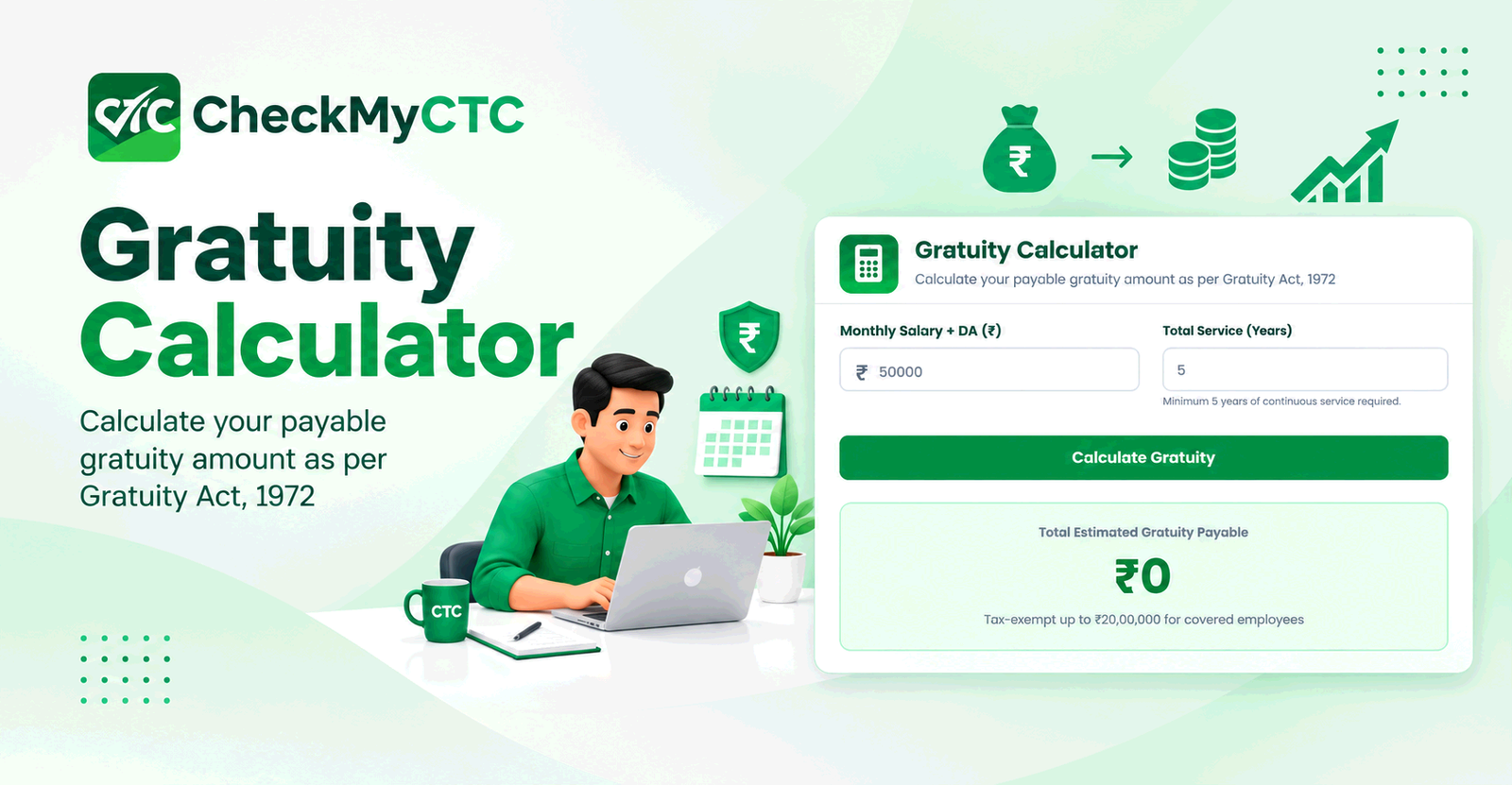
Best Free Gratuity Calculator – Estimate Your Gratuity Amount
When changing jobs, planning retirement, or reviewing a final settlement after years of continuous service, understanding your monetary entitlements is essential. Among various statutory benefits, gratuity serves as an important lump-sum reward paid by employers to acknowledge an employee's long-term dedication. However, figuring out the exact figure manually often leads to confusion regarding eligible salary components, tenure rounding, and statutory guidelines under the Payment of Gratuity Act, 1972.
The CheckMyCTC Gratuity Calculator simplifies this evaluation process. By converting your basic salary figures and total completed years of employment into an instant, realistic payout figure, this tool helps working professionals verify final settlement projections and plan their financial transitions with confidence.
What Is the Gratuity Calculator?
The Gratuity Calculator is an online statutory payout estimation tool designed to determine the payable gratuity benefit due to an employee upon leaving an organization, retiring, or resigning after continuous service. It evaluates your last drawn basic salary, Dearness Allowance (DA), and total tenure to compute an estimated payout based on standard regulatory frameworks.
Rather than making rough estimates based on total Cost to Company (CTC), the calculator isolates the specific salary components mandated by payroll regulations, giving you a realistic picture of your end-of-service compensation.
What Problem Does It Solve?
Calculating statutory gratuity manually is often tricky due to specific formulas, working-day conventions, and tenure adjustments. Common issues employees face include:
- Misunderstanding Salary Inputs: Incorrectly including house rent allowance (HRA), special allowances, or performance bonuses into the calculation base instead of restricting it to Basic Salary and DA.
- Tenure Rounding Ambiguity: Confusion over how months beyond completed years are treated (e.g., whether 5 years and 7 months counts as 6 years).
- Covered vs. Non-Covered Establishment Rules: Uncertainty regarding whether an employer falls under the standard 15/26 working-day formula or a 15/30 monthly divisor method.
- Final Settlement Verification: Difficulty cross-checking HR pay-slips and full-and-final (FnF) settlement statements during resignation.
How the Tool Works
Estimating your gratuity payout using the CheckMyCTC tool takes only a few straightforward steps:
- Input Last Drawn Monthly Salary: Enter your monthly Basic Salary plus Dearness Allowance (DA) as per your most recent salary slip.
- Enter Total Years of Service: Input the total continuous years completed with your current employer.
- Specify Additional Months (If Applicable): Enter any extra months worked beyond completed full years to account for standard tenure rounding rules.
- Select Organization Type: Choose whether your company is covered under the Payment of Gratuity Act, 1972 or follows non-covered establishment guidelines.
- Review Results: The tool instantly displays your estimated total gratuity payout and statutory breakdown.
Understanding the Calculation
Under Indian labor guidelines, the standard statutory formula applied for organizations covered under the Payment of Gratuity Act, 1972 evaluates 15 days of last drawn salary for each completed year of service, using a 26-day working month convention.
$$\text{Gratuity Amount} = \frac{\text{Last Drawn Basic Salary + DA}}{26} \times 15 \times \text{Years of Service}$$
Key Factors that Influence the Formula
- Last Drawn Basic Pay + DA: Gratuity is strictly computed on basic pay and eligible dearness allowance. Other allowances like HRA, LTA, or special allowance are excluded from this specific calculation base.
- The 26-Day Divisor: The law considers 26 working days in a month, assuming 4 weekly off days, making each day's earning equivalent to $1/26$th of monthly basic pay.
- The 15-Day Factor: Employees receive 15 days' worth of daily basic pay for every full year rendered.
- Tenure Rounding Rule: For establishments covered under the Act, service exceeding 6 months in a final partial year is rounded up to the next full year (e.g., 6 years and 7 months is calculated as 7 years).
Practical Example
Consider an employee resigning after 7 years and 8 months of continuous service at a company covered under the Gratuity Act. The employee's last drawn monthly pay stub lists a Basic Salary of $3,000 and DA of $200, bringing the combined monthly base to $3,200.
- Last Drawn Basic Salary + DA: $3,200 per month
- Total Tenure: 7 years and 8 months (Rounded up to 8 years due to exceeding 6 months)
- Daily Pay Equivalent: $3,200 / 26 = $123.08 per day
- 15 Days Pay Equivalent: $123.08 × 15 = $1,846.15 per year of service
- Total Estimated Gratuity Payout: $1,846.15 × 8 years = $14,769.23
By determining this estimate in advance, the employee can verify their final settlement statement provided during the exit process.
Who Can Use This Tool?
- Resigning Employees: Professionals planning a job change who want to calculate expected lump-sum payouts upon exiting.
- Retiring Professionals: Individuals nearing superannuation who need to project long-term service benefits for retirement planning.
- Job Offer Evaluators: Candidates reviewing compensation packages to understand how basic salary structure influences future statutory benefits.
- HR & Payroll Teams: Operations personnel cross-checking preliminary final settlement estimates for offboarding employees.
Key Benefits
- Fast Payout Previews: Obtains instant end-of-service financial estimates without building spreadsheet formulas.
- Eliminates Manual Errors: Automatically applies the standard 15/26 multiplier and month-rounding rules.
- Better Exit Planning: Helps you budget effectively during career transitions, sabbaticals, or retirement decisions.
- Transparent & Simple: Clearly displays how basic salary and tenure interact to form your final gratuity amount.
Comparison: Online Calculator vs. Manual Calculation
Computing statutory benefits manually or through basic spreadsheets can introduce mistakes if month-rounding or day-divisor rules are misunderstood. Here is how using an online utility compares to manual attempts:
| Aspect | CheckMyCTC Gratuity Calculator | Manual Calculation Method |
|---|---|---|
| Calculation Speed | Instant execution in seconds | Requires manual math and formula setup |
| Tenure Rounding | Applies statutory 6-month rounding rules automatically | Risk of misinterpreting partial year rules |
| Working Day Divisor | Pre-configured with standard 26-day basis | Risk of accidentally using 30 or 31 calendar days |
| Risk of Error | Minimal arithmetic error risk | Higher chance of formula and rounding mistakes |
Common Mistakes to Avoid
When calculating your expected gratuity, keep these frequent misunderstandings in mind:
- Using Total CTC Instead of Basic Pay: Calculating gratuity based on overall gross income or CTC creates artificially inflated expectations. Gratuity depends primarily on Basic Salary + DA.
- Assuming Eligibility Before 5 Years: Generally, completion of 5 years of continuous service with an employer is mandatory for gratuity eligibility (with exceptions for death or permanent disablement).
- Ignoring the 6-Month Rounding Rule: Working 5 years and 4 months counts as 5 years, whereas working 5 years and 7 months is treated as 6 years under covered establishment rules.
- Confusing Gratuity with Provident Fund: Provident Fund is a monthly joint contribution plan, whereas gratuity is a separate lump-sum benefit funded entirely by the employer.
Limitations and Important Considerations
While our calculator provides estimates based on standard statutory rules, actual full-and-final payouts can be affected by specific factors:
- Exemption Limits: Tax rules set maximum statutory exemption thresholds on total lifetime gratuity received across employers. Amounts exceeding specified tax limits may attract income tax liability.
- Non-Covered Establishments: Companies not covered under the Payment of Gratuity Act may use a 30-day divisor instead of 26 days, altering daily rate figures slightly.
- Contractual Ex-Gratia Policies: Some corporate policies offer higher voluntary gratuity benefits than the legal minimum statutory formula.
For official payouts, always verify final statements with your company's HR or payroll department during offboarding.
Simplify Statutory Calculations with CheckMyCTC
CheckMyCTC provides practical tools designed to help employees understand salary and workplace calculations. From evaluating job offer structures to estimating end-of-service benefits, clear information helps working professionals make smart career and financial choices.
You can use the free Gratuity Calculator directly on CheckMyCTC to run real-time estimates whenever you review long-term service benefits.
Frequently Asked Questions
What is the minimum service required to receive gratuity?
Under normal circumstances, an employee must complete at least 5 years of continuous service with an organization to become eligible for gratuity payouts upon resignation or termination.
Is gratuity calculated on total CTC or Basic salary?
Gratuity is strictly calculated on your last drawn Basic Salary plus Dearness Allowance (DA). Allowances like HRA, special allowance, medical reimbursements, and performance bonuses are excluded.
How are partial years counted in gratuity calculations?
For organizations covered under the Act, if you have completed 5 years of service, any additional service exceeding 6 months in a year is rounded up to a full year (e.g., 5 years 7 months = 6 years).
Is gratuity payout taxable?
Gratuity received by government employees is generally fully tax-exempt. For private-sector employees, gratuity is tax-exempt up to statutory threshold limits defined by tax regulations, with amounts beyond the limit treated as taxable income.
Can an employer refuse to pay gratuity after 5 years?
If an organization is covered under the Payment of Gratuity Act and an employee completes 5 years of continuous service, the employer is legally obligated to pay gratuity upon separation, except under rare statutory conditions like dismissal for gross misconduct.
Plan Your Service Benefits with Clarity
Evaluating your gratuity payout should not involve guessing or complex manual math. By converting your service history and salary details into clear estimates ahead of time, you gain better control over your career transitions and financial goals. Estimate your statutory payout with the Gratuity Calculator today.
Explore All CheckMyCTC Calculators & Tools
Explore our free salary, tax, HR and productivity tools to calculate salary changes, estimate employee benefits, manage employment dates and simplify everyday tasks.
Salary & CTC Calculators
- Salary Hike Calculator
- Overtime Pay Calculator
- Monthly Salary to Annual Package Calculator
- Annual Package to Monthly Salary Calculator
- Take-Home Salary Calculator
- CTC Breakup Generator
- Monthly Bonus Calculator
- Annual Bonus Calculator
- Job Offer Comparison Calculator
- Pro Rata Salary Calculator
Tax, PF & Employee Benefits
- HRA Tax Exemption Calculator
- EPF Provident Fund Calculator
- Gratuity Calculator
- LTA Calculator
- Professional Tax Calculator
- Income Tax Calculator
- National Pension System (NPS) Calculator
- ESI Calculator
- GST Calculator
Leave & Employment Calculators
- Work Experience Calculator
- Last Working Day Calculator
- Resignation Date Calculator
- Leave Amount & Salary Deduction Calculator
- Notice Period Calculator
- Earned Leave Encashment Calculator
- Sandwich Leave Calculator
- Maternity & Paternity Leave Calculator
Salary Documents & Generators
- Payslip Generator
- Salary Certificate Generator
- Experience & Relieving Letter Generator
- QR Code Generator
Phone Number & Productivity Tools
Leave a Comment
Comments
No comments yet. Be the first to comment!