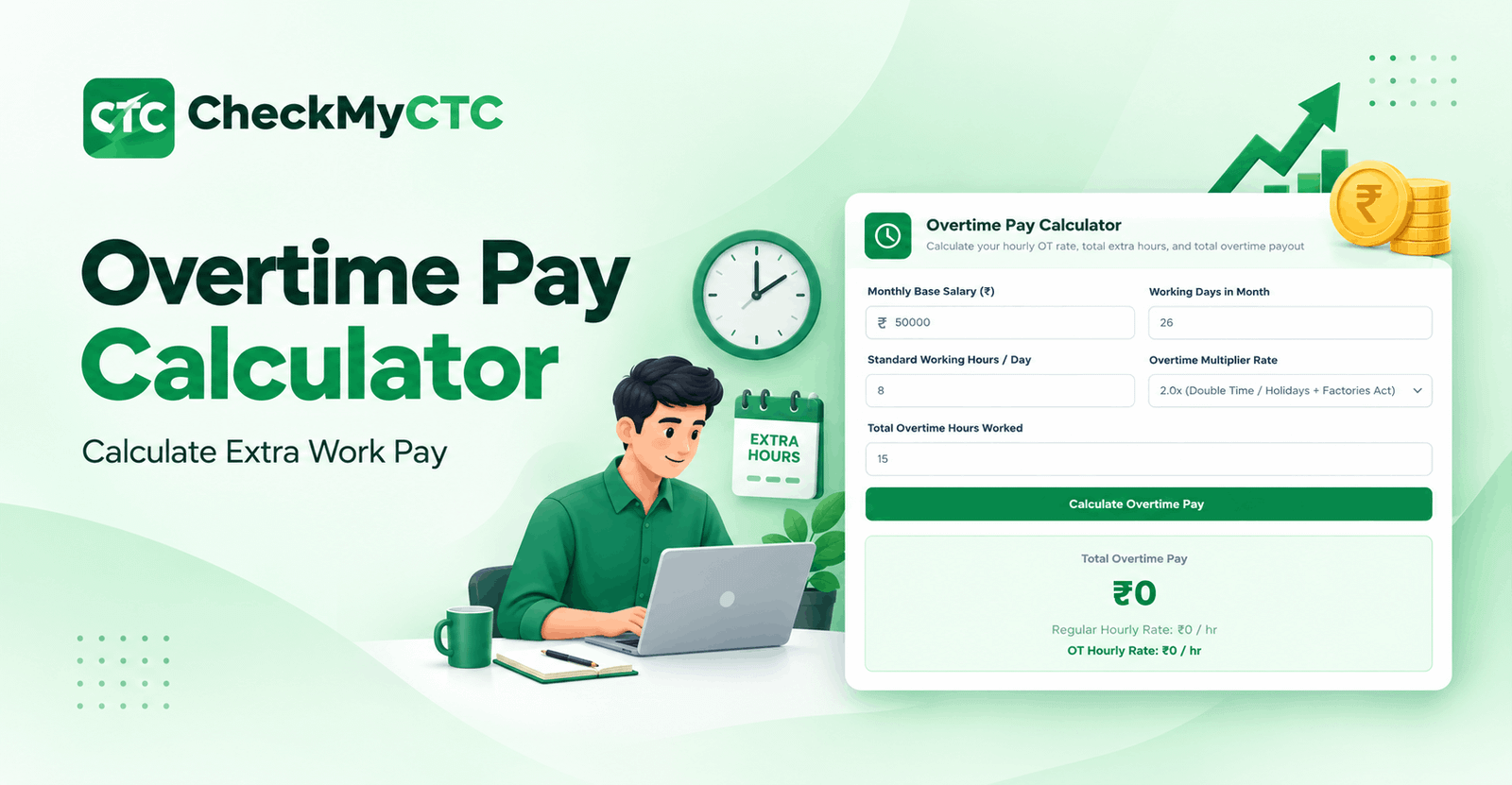
Best Free Overtime Pay Calculator – Calculate Your Extra Work Pay
Working beyond your regular hours can increase your earnings, but calculating the additional amount manually is not always straightforward. You may need to consider your hourly pay, extra hours worked, and the overtime rate applicable to your situation.
The Overtime Pay Calculator from CheckMyCTC provides a simple way to estimate how much you can earn for overtime work. Instead of doing the calculation repeatedly, you can enter the relevant figures and get an estimate of your overtime earnings.
What Is an Overtime Pay Calculator?
An Overtime Pay Calculator is a tool that helps employees estimate additional earnings for hours worked beyond their normal working schedule.
The basic idea is simple: determine the applicable hourly rate, identify the number of overtime hours, apply the relevant overtime rate, and calculate the additional pay.
This can be useful when reviewing a payslip, checking an expected salary payment, planning extra working hours, or simply understanding how overtime affects your earnings.
Why Calculate Overtime Pay?
Extra working hours can make a noticeable difference to monthly earnings. However, it is easy to lose track when overtime happens several times during a month.
A calculator gives you a quick way to separate your regular earnings from the additional amount associated with overtime.
You might use an overtime calculation to:
- Estimate additional earnings from extra working hours.
- Check whether a payroll calculation appears reasonable.
- Understand the value of working additional hours.
- Compare overtime earnings across different numbers of hours.
- Plan your monthly income when overtime is part of your work schedule.
- Keep a simple record of expected overtime earnings.
How Does the Overtime Pay Calculator Work?
The calculation generally starts with your regular pay and converts it into an hourly amount. The overtime hours are then multiplied by the applicable overtime rate.
A simplified calculation can be represented as:
Overtime Pay = Overtime Hours × Overtime Hourly Rate
For example, suppose an employee has an overtime rate of ₹250 per hour and works 8 overtime hours.
₹250 × 8 hours = ₹2,000
In this example, the estimated overtime earnings would be ₹2,000 before considering any applicable deductions or other payroll adjustments.
How to Calculate Overtime Pay Step by Step
-
Determine your regular pay.
Start with the salary or wage information relevant to your employment arrangement.
-
Work out the hourly rate.
If you are paid a monthly salary, the method used to convert salary into an hourly rate may depend on your employer's payroll structure and working-hours calculation.
-
Record the overtime hours.
Add up the additional hours you worked outside your normal schedule.
-
Apply the applicable overtime rate.
The overtime rate may be different from your normal hourly rate depending on the terms of employment and applicable rules.
-
Calculate the additional pay.
Multiply the applicable overtime hourly rate by the overtime hours to estimate the additional earnings.
Practical Example of Overtime Earnings
Consider an employee whose applicable overtime rate is ₹300 per hour. During a particular month, the employee works 10 hours beyond the normal schedule.
The estimated overtime pay would be:
10 × ₹300 = ₹3,000
So, the employee could expect an estimated ₹3,000 in additional overtime earnings before any applicable payroll deductions or adjustments.
The example is intentionally simple because actual payroll calculations can use different salary components, working-hour definitions, or overtime policies.
Who Can Use an Overtime Pay Calculator?
An overtime calculator can be useful for anyone who needs to estimate additional earnings from extra working hours, including:
- Employees working regular overtime.
- Shift workers with varying schedules.
- Hourly-paid workers.
- Working professionals checking expected earnings.
- Job seekers comparing compensation structures.
- HR professionals performing preliminary payroll calculations.
- Employees reviewing overtime-related figures on their payslips.
Benefits of Using an Overtime Calculator
Faster calculations
Instead of calculating the same figures manually, you can use a dedicated calculator to estimate overtime earnings more quickly.
Easier salary planning
If overtime forms part of your expected monthly income, estimating the additional amount can make personal salary planning easier.
Useful for payroll checks
An estimate can help you understand the overtime component when reviewing your salary statement or discussing payroll with your employer.
Simple comparison
You can compare different overtime scenarios, such as working 5, 10, or 20 additional hours, to understand how extra hours could affect your earnings.
Overtime Pay and Your Regular Salary
Overtime earnings are generally an additional component rather than a replacement for your normal salary. The way overtime appears in payroll can vary between employers.
For example, an employee may have regular monthly earnings along with a separate overtime component on the payslip. In other situations, overtime may be calculated using an hourly wage or a particular salary component defined by the employer.
This is why an online calculation should be treated as an estimate unless it matches the exact payroll rules and employment terms applicable to you.
What Can Affect Overtime Pay?
The final overtime amount may vary because employers and employment arrangements can use different calculation methods.
Factors that may need to be considered include:
- The employee's basic or applicable wage.
- The number of normal working hours used for the calculation.
- Total overtime hours.
- The overtime multiplier or rate.
- Company overtime policies.
- Employment terms and applicable labour rules.
- Whether particular days or shifts have different overtime treatment.
- Payroll deductions or adjustments.
Important Considerations Before Using the Result
An overtime calculator provides an estimate based on the information entered. The result should not automatically be treated as the exact amount that will appear in your salary account.
Different companies can define normal working hours, eligible salary components, overtime rates, and payroll periods differently. Applicable employment rules can also affect how overtime should be calculated.
If your employer provides a specific overtime policy or calculation method, use that information when verifying the final amount.
Why Use CheckMyCTC for Overtime Calculations?
CheckMyCTC is designed around practical salary and employee-focused tools. The goal is to make common salary-related calculations easier to understand without requiring complicated spreadsheets or manual formulas.
The Overtime Pay Calculator fits into that approach by helping employees estimate the value of additional working hours and understand how overtime can affect their earnings.
For a quick calculation, you can try the free Overtime Pay Calculator on CheckMyCTC.
Frequently Asked Questions
How do I calculate overtime pay?
A simplified calculation is to multiply the number of overtime hours by the applicable overtime hourly rate. The exact method can vary depending on your salary structure, employer policy, and applicable employment rules.
Can I calculate overtime from my monthly salary?
Yes. A monthly salary can be converted into an hourly amount using the working-hours method applicable to your employment arrangement. The resulting hourly rate can then be used with the applicable overtime rate.
Is overtime pay the same for every employee?
No. Overtime calculations can differ depending on the employee's pay structure, working hours, employment terms, company policy, and applicable rules.
How much will I earn for 10 hours of overtime?
It depends on your applicable overtime hourly rate. For example, at ₹300 per overtime hour, 10 hours would produce an estimated ₹3,000 before applicable deductions or adjustments.
Can an overtime calculator be used to check a payslip?
Yes. It can provide a useful estimate for comparison. However, your employer's payroll calculation should be used as the final reference because the underlying salary components and overtime rules may differ.
Does overtime pay include salary deductions?
An overtime calculator generally focuses on estimating the overtime earnings. The amount ultimately received may be affected by applicable payroll deductions, taxes, or other adjustments.
Can I use an overtime calculator in India?
Yes, you can use an overtime calculator in India to estimate additional earnings. However, the actual overtime entitlement and calculation method depend on the employment arrangement, company policy, and applicable rules.
Calculate Your Extra Working-Hour Earnings
Overtime can be an important part of an employee's total earnings, but calculating it manually can become inconvenient when extra hours change from month to month. A dedicated calculator provides a quick way to estimate the additional amount and understand the relationship between overtime hours and pay.
Use the CheckMyCTC Overtime Pay Calculator to estimate your overtime earnings, then compare the result with your employment terms and payroll information when checking your actual payment.
CheckMyCTC also focuses on practical salary and employee tools that help make everyday compensation calculations easier to understand.