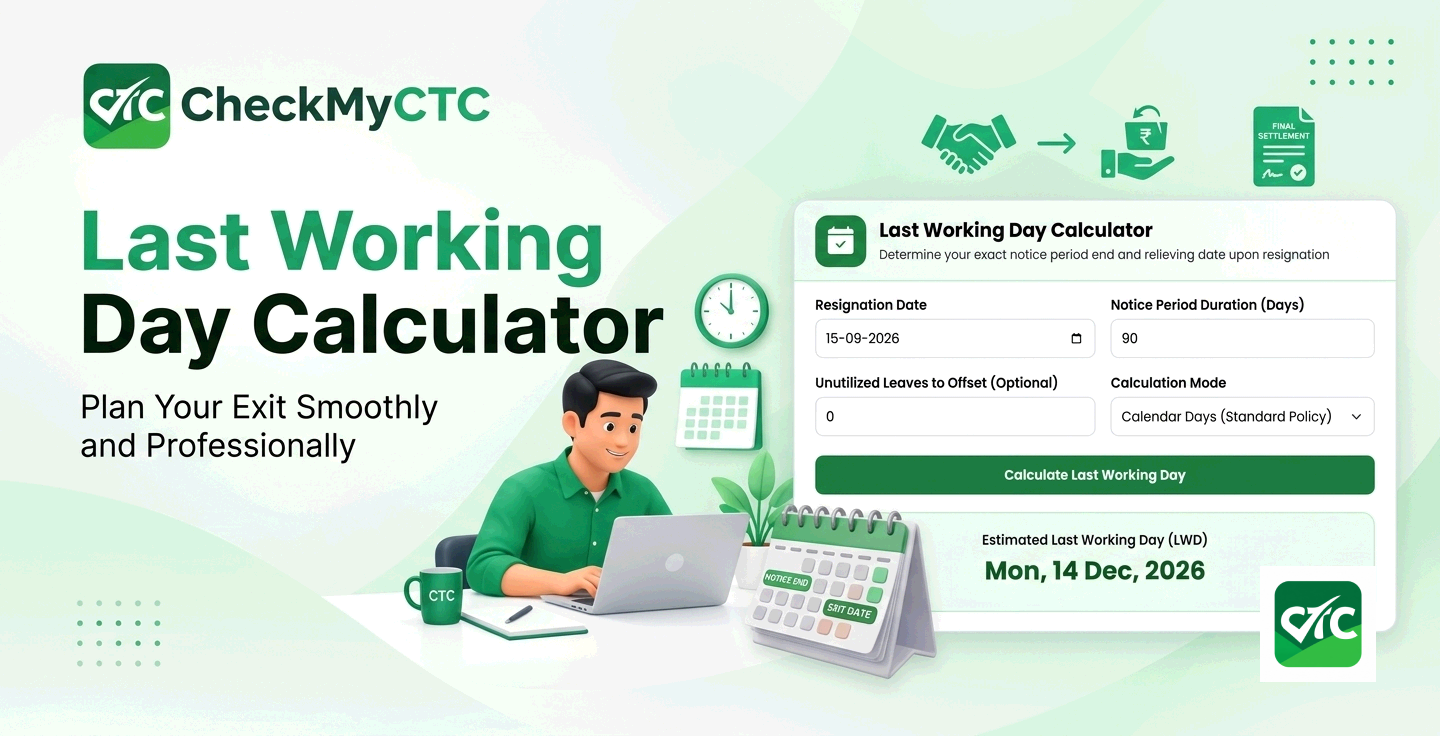
Best Free Last Working Day Calculator – Calculate Your Relieving Date and Notice Period End Date
Resigning from a job involves coordinating multiple moving parts, from handing over project documentation to planning your onboarding at a new company. One critical detail in this transition is identifying your official exit date. Miscalculating your notice period can lead to overlapping employment dates, delayed joining timelines, or misunderstandings with HR departments.
Determining your exact notice period end date isn't always as simple as adding 30 or 90 days to your resignation date. Weekends, company policy variations, and national holidays often complicate the schedule. Using a dedicated Last Working Day Calculator helps you establish your final working date quickly, allowing you to plan your career move with certainty.
What Is a Last Working Day Calculator?
A Last Working Day Calculator is an online utility designed to compute the precise date an employee completes their official duties after submitting a formal resignation. By combining your initial resignation date with your contractually required notice period duration, the tool pinpoints the exact date you finish work and become eligible for your relieving documentation.
Instead of manually counting days on a calendar and risking counting errors, this digital tool processes the timeline instantly. It establishes clear boundaries for both departing employees and HR teams, ensuring total transparency during offboarding.
Common Challenges When Determining Your Exit Date
Transitioning out of a role seems simple on paper, but real-world scenarios frequently introduce friction points. Employees routinely encounter several issues when trying to compute their final date manually:
- Calendar Day vs. Working Day Ambiguity: Company contracts vary. Some employment agreements count notice periods in total calendar days, while others strictly count active working days, skipping weekends.
- Uncertainty Around Non-Working Days: Falling on weekends or official company holidays can make pinpointing the final physical day in the office confusing.
- Overlapping Joining Dates: New employers typically require a confirmed joining date before issuing formal offer letters. An error in calculating your notice period end date can delay your start at the next firm.
- Shortfall and Buyout Confusion: If you plan to leave earlier than the contractual requirement, calculating the exact number of days served versus the remaining shortfall requires accurate baseline counts.
How the Last Working Day Calculator Works
Calculating your exit timeline is straightforward. The tool takes your inputs and calculates the timeline based on standard date logic:
- Input Resignation Submission Date: Select the exact date you submit your official resignation notice to your manager or HR team.
- Enter Required Notice Period: Specify the duration required by your employment contract (commonly 30, 60, or 90 days).
- Account for Specific Adjustments: Factor in specific details such as non-working days or custom contractual terms if applicable.
- Review Results: The tool outputs your exact notice period completion date and officially calculated relieving date.
Practical Example of Last Working Day Calculation
To see how the timeline works in practice, consider a standard professional scenario:
Suppose an employee hands in their formal resignation letter on October 1st. Their employment agreement stipulates a standard 60-day notice period calculated on a calendar-day basis.
- Resignation Date: October 1
- Contractual Notice Duration: 60 Days
- Notice Completion Date: November 30
In this scenario, assuming November 30 falls on a standard working day, that date serves as the final official working day. If November 30 falls on a Sunday, official offboarding tasks might wrap up on Friday, November 28, while employment formally ends on November 30. Relying on an automated tool eliminates manual counting mistakes and brings immediate clarity to both parties.
Who Needs to Calculate Their Relieving Date?
Accurate departure timelines benefit various professionals across industries:
- Resigning Employees: Professionals needing to communicate an accurate available start date to prospective employers.
- Hiring Managers and Recruiters: Talent acquisition teams checking candidate availability and establishing practical onboarding schedules.
- HR and Payroll Teams: Offboarding specialists preparing full and final settlement (FnF) paperwork, non-disclosure agreements, and service certificates.
- Contract Workers and Consultants: Independent professionals completing fixed-term engagements who need precise end-of-contract dates.
Why Use the CheckMyCTC Exit Planning Tools?
At CheckMyCTC, our primary focus is bringing clarity to complex career, salary, and employment calculations. Transitioning between roles involves more than just calculating financial payouts; it requires managing timeline details accurately.
By using the free Last Working Day Calculator on CheckMyCTC, you gain an easy-to-use, reliable resource designed to make professional exits transparent and hassle-free. It integrates seamlessly into your overall transition strategy alongside our suite of salary, tax, and exit planning resources.
Important Factors and Limitations to Consider
While an online calculator provides a fast baseline, actual notice period requirements depend on specific terms and conditions outlined in your employment agreement:
- Contract Terms Take Precedence: Always review your official offer letter or employment contract. Individual policies regarding calendar days versus business days vary by employer.
- Unapproved Leaves: Taking unauthorized leave during your notice period may extend your final working date by the equivalent number of days worked.
- Notice Period Buyout: If your employer permits paying salary in lieu of notice, your actual exit date may be adjusted based on mutual agreement.
- Early Release Requests: Early waivers are subject entirely to management approval and company discretion, regardless of standard calculator outputs.
Frequently Asked Questions
Does notice period include weekends and public holidays?
In most corporate policies, notice periods are calculated using consecutive calendar days, which includes weekends and public holidays. However, certain organizations calculate notice periods strictly using business working days. You should confirm the exact policy with your HR handbook.
What happens if my last working day falls on a holiday or weekend?
If your calculated end date falls on a non-working day, your formal employment contract usually terminates on that calendar date, but your physical handover and asset return take place on the final preceding working day.
Can I shorten my notice period by using remaining leave balances?
Many organizations allow employees to adjust accrued paid leave against their notice period duration, effectively pushing forward their physical last working day. This practice requires formal approval from your reporting manager and HR department.
How can I verify my exit date with my employer?
You can verify your timeline by using our online Last Working Day Calculator to generate an initial baseline, then submitting those details in your formal resignation email for written acknowledgement from HR.
Is the relieving date the same as the notice period end date?
Yes, in most standard employment contexts, your relieving date coincides directly with the final date of your notice period, marking the official end of your employment relationship.
Final Thoughts on Planning Your Career Transition
Managing your resignation smoothly sets a positive, professional tone for your career transition. Knowing your exact exit schedule prevents scheduling conflicts and allows you to coordinate with your new employer confidently. Take control of your transition timeline today by accessing the CheckMyCTC Last Working Day Calculator to compute your relieving date accurately.